
Iran Targets U.S. Bases Across the Middle East in Response to U.S.–Israel Strikes


After weeks of escalating tensions, diplomatic warnings, and military preparations, the United States and Israel have launched direct military operations against Iran. On Saturday, U.S. President Donald Trump announced that a “major military operation” against Iran had begun. He claimed that the objective of the campaign is to topple Iran’s ruling establishment and ensure regional security.
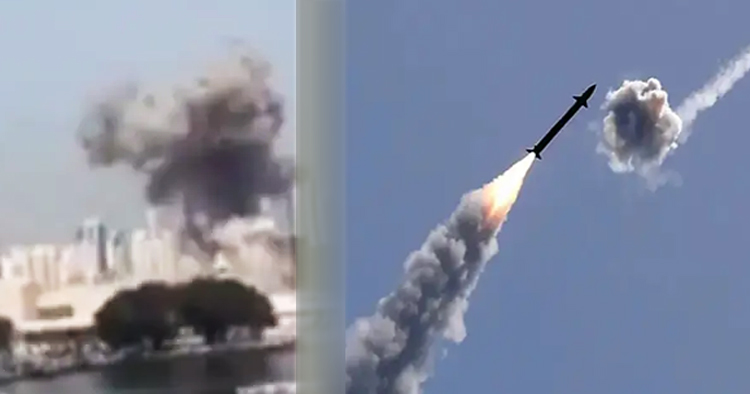
Earlier on Saturday at dawn, Israel carried out missile and air strikes on several key Iranian cities, including the capital, Tehran. The attacks reportedly targeted Iran’s defense infrastructure, military installations, and strategic facilities. Explosions were heard across parts of Tehran, with plumes of smoke visible in the sky. Iranian authorities claimed that civilian facilities were also damaged in the strikes.
In swift retaliation to the joint U.S.–Israeli assault, Tehran launched a broad counteroffensive. Iran’s state-run Fars News Agency reported that the country’s armed forces began extensive missile strikes targeting U.S. military bases and infrastructure across the Middle East. Explosions and attacks have been reported in at least six countries.
Missiles were fired at Al Udeid Air Base in Qatar, the largest U.S. military base in the region. Qatar’s Ministry of Defense stated that several incoming missiles were intercepted using Patriot air defense systems. Iran also claimed to have targeted Al Salem Air Base in Kuwait and Al Dhafra Air Base in the United Arab Emirates.
In the UAE, international media reported that one person was killed in a missile strike in the capital, Abu Dhabi. The Emirati government condemned the attack as a violation of international law and its territorial integrity, vowing an appropriate response. Following the explosions in Abu Dhabi, blasts were also heard in Dubai, further heightening regional alarm.
In Bahrain, Iranian missiles reportedly struck near the headquarters of the U.S. Fifth Fleet. Smoke was seen rising from the Juffair area in the capital, Manama. Bahrain’s Interior Ministry confirmed explosions but did not provide detailed information about damage or casualties. Explosions were also reported in Jordan around the same time.
Saudi Arabia’s capital, Riyadh, also experienced multiple large explosions, according to international news agencies. Witnesses reported seeing air defense systems activated in the sky. However, the exact cause of the blasts and the extent of any damage remain unclear.
Iran also launched fresh missile attacks directly targeting Israel. Explosions were heard in Tel Aviv, Israel’s commercial capital. It remains uncertain whether Iranian missiles directly hit their targets or were intercepted by Israeli air defense systems.
In an official statement, Iran’s Foreign Ministry described the U.S. and Israeli military actions as a clear violation of international law and the principles of the United Nations Charter. Tehran asserted that it has the legitimate right to take firm and lawful measures in response to attacks on its sovereignty and territorial integrity. The statement warned that all U.S. and Israeli interests in the region have now become legitimate targets and that the aggressors would be forced to regret their actions.
Meanwhile, U.S. officials stated that the objective of the operation is to dismantle Iran’s military capabilities and restore regional stability. However, analysts warn that the confrontation could rapidly escalate into a broader regional war, with significant consequences for global energy markets, the world economy, and international diplomacy.
With U.S. military presence spread across multiple Middle Eastern countries, the conflict has taken on a complex and multi-layered dimension. The situation continues to evolve rapidly, and escalating retaliatory strikes have pushed tensions to a critical level. Although the international community has expressed deep concern, there are no clear signs yet of an imminent ceasefire.